Waking up every morning and hating your brows is exhausting. Whether your microblading removal is long overdue or you’re dealing with a color that shifted into something unrecognizable — you have real options. Eyebrow tattoo removal has become one of the most requested cosmetic procedures across the USA. Styles change. Pigments fade wrong. Artists make mistakes.
None of that means you’re stuck forever. From laser treatments to saline methods, permanent makeup removal today is safer, more effective, and more accessible than ever before. This guide breaks down every method, cost, and result honestly — so you can walk into your first consultation fully informed and completely confident.
What Is Eyebrow Tattoo Removal? (And Who Needs It)
Most people think eyebrow tattoo removal simply means erasing ink. It’s actually more nuanced than that. Removal means breaking down pigment deposited under your skin — whether it’s from microblading, powder brows, or old-school tattooing. A licensed dermatologist, PMU artist, or cosmetic clinic performs the procedure. The goal is either full clearance or enough brow tattoo fading to allow a fresh design on top. Permanent makeup removal isn’t instant. It takes time, patience, and the right professional.
So who actually needs it? More people than you’d think. Trends change fast. The bold, blocky brows of the early 2000s look nothing like today’s natural arches. Many clients also deal with botched brows — uneven shapes, wrong placement, or reddish/rusty brow discoloration that developed over time. Others simply want a clean slate. If your brows have shifted to an unflattering purple-grey discoloration or the pigment has spread beyond the original lines, cosmetic tattoo removal might be exactly what you need.
Types of Eyebrow Tattoos That Can Be Removed
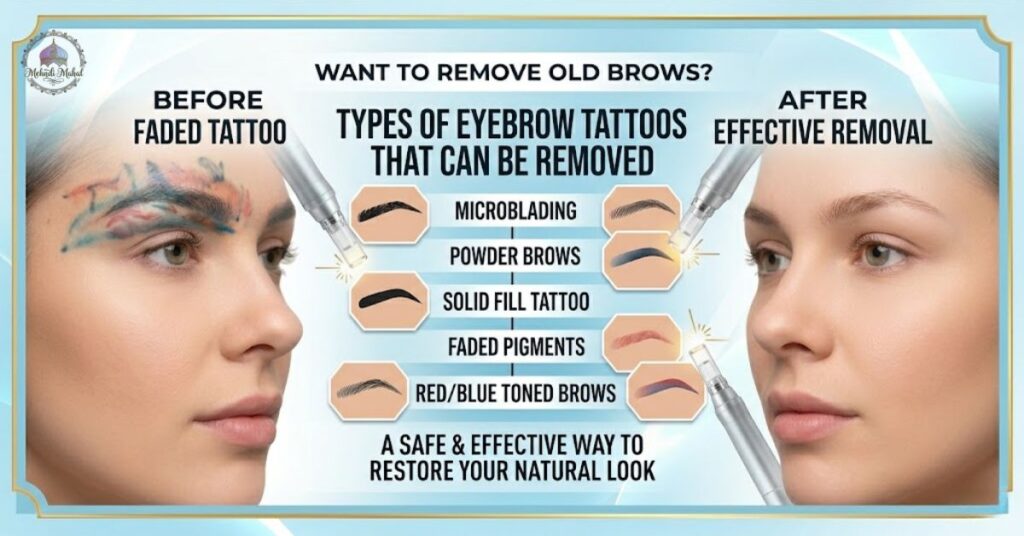
Not every brow tattoo behaves the same way under removal treatment. The technique used to apply your brows directly affects how easy — or difficult — removal will be. Shallow vs deep pigment placement matters enormously here. Artists who implanted ink too deep created a much harder removal problem. Understanding your brow type helps you set realistic expectations before you book your first session.
Different brow styles also use different cosmetic tattoo ink formulas. Some pigments respond beautifully to laser. Others — especially those with iron oxide in tattoo ink — can react unpredictably. Knowing what type of brows you have is the first step toward a successful PMU removal journey.
Microblading
Microblading uses a hand tool to create fine, hair-like strokes. Ink sits relatively shallow in the skin. That’s actually great news for removal. Microblading removal tends to require fewer sessions than other methods. Most cases respond well to both laser and saline treatments. Newer microblading brows — especially those 1 to 3 year old brow tattoos — often clear up in just a few visits.
Traditional Eyebrow Tattooing
Old-school eyebrow tattoos used body tattooing techniques and traditional tattoo ink. These machines pushed pigment much deeper into the skin. The dermis implantation depth was far greater than modern PMU (permanent makeup) standards allow. That’s why 10 to 15 year old tattoos are notoriously stubborn. They may never fully disappear — even after a dozen laser removal sessions.
Powder Brows & Ombre Brows
Powder brows and ombre brows use a shading technique. Ink depth is moderate — not as shallow as microblading but not as deep as traditional tattooing. Removal difficulty depends heavily on the cosmetic tattoo ink brand used. Some pigments lift beautifully. Others resist treatment. Always ask your removal specialist about your specific pigment before committing to a method.
Eyebrow Tattoo Removal Methods: Which One Is Right for You?
Choosing the wrong removal method can make things significantly worse. That’s not a scare tactic — it’s a clinical reality. For example, using laser on iron oxide in tattoo ink without a test patch first can trigger the paradoxical darkening effect. Your brows could turn permanently black. Every method has its strengths. The right choice depends on your brow type, pigment, skin tone, and budget. A qualified specialist will assess all of these before recommending anything.
The four main methods used in the USA today are laser removal, saline removal, emergency removal, and — though not recommended — DIY home options. Tattoo ink breakdown happens differently with each approach. Laser shatters pigment with light energy. Saline draws it to the surface through osmosis. Understanding the mechanism helps you ask better questions when consulting a clinic. Never skip the consultation step. It could save you months of unnecessary treatments.
Laser Eyebrow Tattoo Removal
Laser is the most widely used method for eyebrow tattoo removal in the USA. Q-switched and Nd:YAG lasers target pigment molecules with concentrated light pulses. The energy causes pigment breakdown at a cellular level. Ink oxidisation happens rapidly — you’ll often see frosting under laser immediately after treatment. Most clients need between 3 and 10 laser removal sessions spaced 6–8 weeks apart. Cost per session typically runs $200–$500 depending on your location and clinic. Laser works best on dark, saturated pigments but requires extra caution with iron-based ink darkening.
Saline Eyebrow Tattoo Removal
Saline removal is gentler than laser. A technician tattoos a saltwater solution into the treated area. The high osmotic concentration pulls pigment upward toward the skin’s surface. It then scabs and flakes away naturally. This method works especially well for microblading removal and lighter pigments. It’s less likely to cause pigment migration or the dreaded paradoxical darkening effect. Sessions cost between $150–$350 in most US states. You’ll typically need 3–8 sessions for meaningful brow tattoo fading.
Emergency Tattoo Removal Options
Acted fast after a bad brow job? You may have options. Within the first 48 hours, emergency saline removal can intercept fresh pigment before it fully sets. Some artists also use glycolic acid solutions in this window. These aren’t permanent fixes — they’re damage-control tools. The earlier you act, the better your outcome. If your brows look wrong the moment you leave the studio, don’t wait. Call a PMU removal specialist immediately.
DIY Home Removal — Why It’s Risky
Let’s be honest — the internet is full of DIY removal “hacks.” Lemon juice. Salt scrubs. Hydrogen peroxide. None of them work on permanent makeup removal. Worse, they can cause chemical burns, permanent scarring, and deep skin infections. Cheap pigments used in some studios are already unpredictable. Applying unregulated substances on top is genuinely dangerous. Always — always — go to a licensed professional for eyebrow tattoo removal. Your skin isn’t worth the risk.
Laser vs Saline Eyebrow Tattoo Removal — Head-to-Head Comparison
Laser gets all the headlines but saline quietly delivers impressive results — especially for delicate microblading removal cases. Both methods have loyal followings in the professional PMU community. The truth is neither one is universally superior. It comes down to your specific brows, your skin type, and what pigment was used. Some advanced clinics now combine both methods for stubborn cases — using laser to break down deeper ink and saline to draw residual pigment to the surface. This combination approach is gaining traction across the USA.
Here’s the clearest way to compare them side by side:
| Factor | Laser Removal | Saline Removal |
| Best for | Dark, deep pigments | Shallow, light pigments |
| Pain level | Moderate to High | Low to Moderate |
| Sessions needed | 3–10 | 3–8 |
| Cost per session | $200–$500 | $150–$350 |
| Risk of darkening | Yes — with iron oxide ink | No |
| Healing time | 1–2 weeks | 1–2 weeks |
| Scar risk | Low if done correctly | Low |
| Widely available in USA | Yes | Moderately |
Which Method Works Faster?
Laser typically delivers faster visible results for dense, heavily saturated pigment. Pigment breakdown happens at a deeper level with each session. However, saline works faster for shallow microblading pigments. Some experienced cosmetic tattoo artists now offer a blended protocol — alternating between both methods across multiple touch up sessions to maximize clearance speed without damaging the skin.
Which Is Less Painful?
Saline wins on the pain scale — hands down. Laser feels like a rubber band snapping repeatedly against your brow bone. It’s tolerable but sharp. Saline feels more like a standard tattoo application. Both methods allow numbing cream applied 30–45 minutes before treatment. Individual pain tolerance varies widely. If you have sensitive skin or a low pain threshold, discuss numbing options with your provider before your first session.
Before and After: Real Eyebrow Tattoo Removal Cases
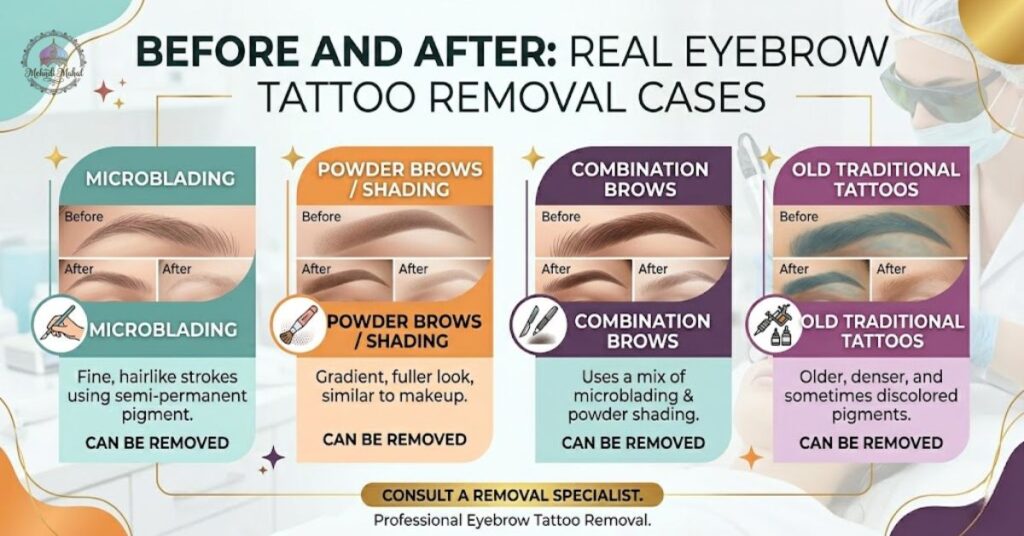
Real laser eyebrow tattoo removal before and after cases tell the most honest story. Clinical photos reveal what no marketing brochure will. Some clients achieve stunning, near-complete clearance after just 2 sessions. Others spend years working through stubborn, layered pigment with mixed results. The pattern that emerges across hundreds of documented cases is consistent. Newer brows with quality pigment and correct depth clear fastest. Older, overseas, or deeply implanted brows are a different story entirely.
Adelaide-based PMU artist Sara Mac studied 100 women with botched brows or unhappy tattoo outcomes. Her case study revealed a striking pattern. Brows done within the last 1–3 years responded well to removal — often clearing in just 1–2 laser removal sessions. Older brows with ink layering from years of touch up sessions showed dramatically poorer results. Some never reached full clearance despite over a dozen treatments. The long-term pigment behavior in aged cosmetic tattoos is fundamentally different from fresh work.
What Successful Removals Had in Common
Successful cases shared three consistent traits. First, the brows were relatively new — typically 1 to 3 year old brow tattoos. Second, quality compliant pigment suppliers had provided the original ink. Third, shallow vs deep pigment placement was appropriate for the client’s skin type. When all three factors aligned, removal was fast, clean, and often complete. The brow correction results in these cases were genuinely impressive — giving clients a fresh canvas to work with.
When Microblading Goes Wrong
One of Sara Mac’s most referenced cases involved a client whose microblading was performed too deep. The artist used incorrect pressure for that client’s brittle skin type. Blood ran during the procedure — a clear red flag. The result was severe pigment encapsulation and pronounced scar tissue. After 5 sessions with Sara and 12 at a previous clinic, the brows still hadn’t fully cleared. This is what pigment entrapment looks like in practice. It’s not just aesthetically frustrating — it’s a clinical complication requiring expert intervention.
Why Some Eyebrow Tattoos Are Harder to Remove
Here’s a truth most removal clinics won’t tell you upfront. Not every brow tattoo can be fully removed. Some cases hit a ceiling — lightening significantly but never reaching complete clearance. Pigment entrapment and pigment migration are the two biggest culprits. When ink embeds too deeply into the dermis or migrates away from the original strokes, laser energy can’t always reach it effectively. This is especially true for 10 to 15 year old tattoos where the molecular structure of the pigment has chemically changed over time.
Unregulated foreign inks add another layer of complexity. Sara Mac’s case study highlighted multiple clients tattooed in countries with little cosmetic ink regulation. These inks contained unknown chemical ingredients and higher oxide levels than domestic products. Standard US laser settings didn’t recognize the pigment. One client from the Middle East experienced frosting under laser with zero ink oxidisation — completely atypical behavior. Her removal required 8 sessions over 2 years just to achieve partial clearance.
Newer vs Older Brow Tattoos
Fresh brows are simply easier to remove. 1 to 3 year old brow tattoos have fewer embedded layers. The pigment hasn’t had time to migrate or change chemically. 10 to 15 year old tattoos, by contrast, often show green-grey hue or purple-grey discoloration — signs that the ink has oxidized and shifted deep into the skin. Sara Mac documented a client with a 15-year-old brow tattoo. After one session, the color only lightened by 30%. No further improvement was possible.
Pigments That Sink Deeper Over Time
Pigment sinking deeper is a gradual process. Initially, cosmetic ink sits near the skin’s surface. Over months and years, those pigment molecules migrate downward into deeper skin layers. Pigment migration is accelerated by sun exposure, skin aging, and repeated touch up sessions. Once pigment reaches the deeper dermis, it becomes pigment encapsulation — essentially locked inside the skin’s structural tissue. Standard laser removal sessions struggle to break down encapsulated pigment effectively.
The Paradoxical Darkening Effect
This is one of the most alarming complications in eyebrow tattoo removal. When iron oxide in tattoo ink is present, laser energy can trigger a chemical reaction that turns the pigment black. Permanently. Sara Mac found this happened in roughly 50% of iron oxide cases during the second laser session. The paradoxical darkening effect occurs because laser reduces ferric oxide (Fe₂O₃) to ferrous oxide (FeO) — a darker compound. Once black, the ink is virtually impossible to remove. A test patch before full treatment is non-negotiable. Always.
Overseas Tattoos & Unregulated Pigments
Getting brows tattooed abroad might seem like a bargain. The long-term costs — financially and physically — often tell a different story. Overseas tattoo concerns are well-documented. Unregulated foreign inks frequently contain higher oxide levels and unknown chemical ingredients not found in FDA-reviewed domestic pigments. US lasers are calibrated for regulated ink formulas. When foreign pigment doesn’t respond as expected, removal timelines stretch dramatically. Several of Sara Mac’s overseas clients needed 8–12+ sessions with inconsistent results throughout.
How Many Sessions Does Eyebrow Tattoo Removal Take?
The number one question every botched brow client asks is simple. How long will this take? The honest answer: it depends. There’s no universal timeline. Multiple removal sessions are always required — no single treatment erases a tattoo completely. The main variables are tattoo age, pigment type, ink depth, skin type, and whether the work was done domestically or overseas. A qualified specialist can give you a realistic estimate after assessing your specific brows in person. Never trust anyone who promises full removal in one session.
On average, expect anywhere from 1 session for brand-new, shallow microblading to 15+ sessions for old, heavily saturated traditional eyebrow tattoos. The 2–3 year refresh cycle recommended by responsible PMU artists also impacts removal difficulty. Clients who refreshed their brows too frequently built up excessive ink layering — making removal far more complex and expensive. Here’s a practical breakdown:
| Tattoo Type | Age | Method | Estimated Sessions |
| Microblading | 1–3 years | Laser | 1–3 |
| Microblading | 5+ years | Laser | 4–8 |
| Traditional tattoo | 10–15 years | Laser | 8–15+ |
| Powder brows | 2–4 years | Saline | 3–6 |
| Overseas pigment | Any age | Laser | 8–12+ |
How Much Does Eyebrow Tattoo Removal Cost?
Eyebrow tattoo removal costs in the USA vary widely depending on your location, the method used, and how many sessions you need. Major metro areas like New York, Los Angeles, and Miami charge premium rates. Smaller cities and rural areas tend to be more affordable. One thing is consistent — this isn’t cheap. Budget accordingly. Trying to cut costs by choosing an under-qualified provider often leads to complications that cost even more to fix later.
The total investment for complete removal can range from a few hundred dollars for simple microblading removal to several thousand for stubborn, aged brow tattoos. Cosmetic tattoo removal is almost never covered by insurance since it’s classified as elective. Some clients use FSA or HSA funds to offset costs — worth checking with your provider. Here’s a realistic USA cost breakdown:
| Method | Cost Per Session | Total Estimated Cost |
| Laser removal | $200–$500 | $600–$5,000+ |
| Saline removal | $150–$350 | $450–$2,800 |
| Emergency saline | $100–$250 | One-time if early |
| Combination method | $250–$600 | $750–$4,500 |
Does Insurance Cover Eyebrow Tattoo Removal?
Standard health insurance doesn’t cover permanent makeup removal in the USA. It’s categorized as a cosmetic elective procedure. However, Flexible Spending Accounts (FSA) and Health Savings Accounts (HSA) may be applicable in some cases. Policies differ between providers and employers. Always call your benefits administrator before assuming coverage. Some clinics offer payment plans — ask at your consultation.
Is Eyebrow Tattoo Removal Safe? Risks & Side Effects
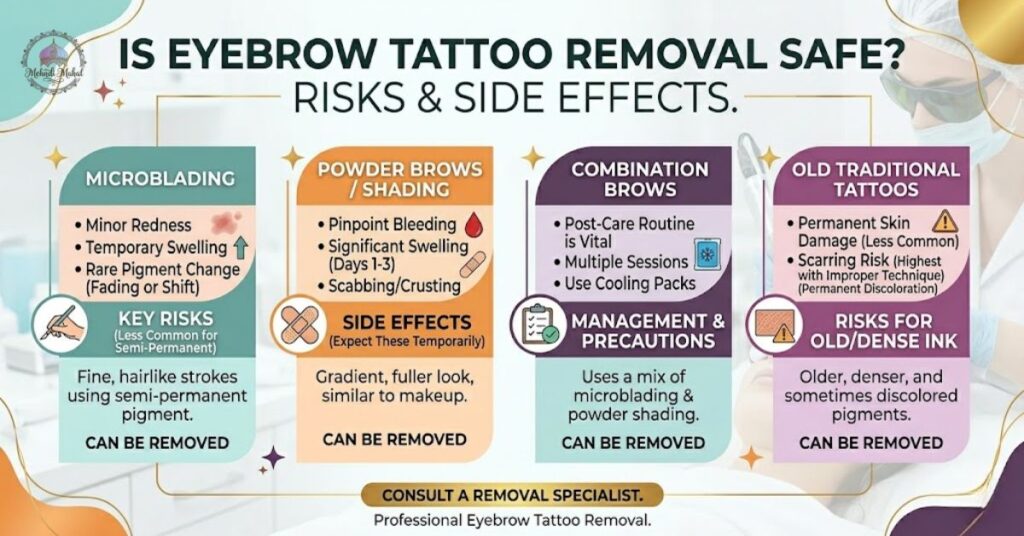
When performed by a licensed, experienced professional, eyebrow tattoo removal is generally safe. The key phrase there is “licensed and experienced.” This isn’t a procedure for discount pop-up studios or unverified practitioners. The area around your eyes is delicate. Improper laser settings, skipping the test patch, or using the wrong method for your specific iron oxide ink composition can lead to serious complications. Always verify credentials before booking. Check reviews. Ask for before-and-after portfolios. Your safety depends on it.
The most dangerous risk — beyond the obvious infection concern — is the paradoxical darkening effect. This occurs specifically with iron-based ink darkening and turns affected pigment permanently black. Pigment migration caused by aggressive treatment is another real risk. Overworked skin can push pigment into unintended areas, creating a shadow or blur effect around the brow line. A good specialist minimizes these risks through proper assessment, conservative settings, and mandatory test patches before full treatment.
Short-Term Side Effects
Short-term reactions are normal and expected. Immediately after treatment, most clients experience redness, swelling, and mild blistering in the treated area. Frosting under laser — a temporary whitening of the skin — occurs during the session itself and resolves within minutes to hours. Scabbing typically develops over the following days and should never be picked. Some clients notice temporary reddish/rusty brow discoloration or a yellowish residue after removal during the healing phase. These effects typically resolve within 1–2 weeks.
Long-Term Risks
Long-term risks are less common but worth knowing. Scarring is possible — particularly if laser settings are too aggressive or the client picks at scabs during healing. Permanent hypopigmentation (lighter patches) or hyperpigmentation (darker patches) can develop in sensitive skin types. Pigment encapsulation occasionally leaves a faint green-grey hue or yellowish residue after removal that doesn’t fully clear even after maximum sessions. This is more common in 10 to 15 year old tattoos or cases involving unregulated foreign inks. The test patch remains your single best protection against severe outcomes.
How to Choose the Right Removal Clinic or Artist
Choosing the right clinic for eyebrow tattoo removal is arguably more important than choosing the method itself. A skilled specialist using saline will outperform an inexperienced technician using the most expensive laser on the market. In the USA, look for clinicians certified in laser procedures or PMU removal specifically. Dermatologists and licensed aestheticians with documented removal training are your safest options. Don’t be shy about asking for proof of certification — any legitimate professional will welcome the question.
Red flags are easy to spot once you know what to look for. Clinics that skip the consultation, refuse to do a test patch, or promise complete removal in a single session are not trustworthy. Pressure tactics, vague pricing, and no before-and-after portfolio are serious warning signs. Cosmetic tattoo removal is a medical-adjacent procedure. Treat it with that level of seriousness. A good specialist will give you a realistic timeline, explain the long-term pigment behavior of your specific brows, and never overpromise results.
Questions to Ask Before Booking
Walk into every consultation prepared. Here are the essential questions every client should ask:
- Do you perform a mandatory test patch before full treatment?
- What laser type and wavelength do you use for brow correction?
- How many eyebrow tattoo removal cases have you handled?
- Have you treated overseas tattoo concerns or unregulated foreign inks before?
- What’s your protocol if the paradoxical darkening effect occurs?
- Can you show me real laser eyebrow tattoo removal before and after photos from your own clients?
Tips for Artists: How to Prevent Brows from Becoming Permanent
Every responsible PMU artist should understand removal — even if they never perform it themselves. The choices you make during application directly determine whether your client’s brows can ever be corrected or refreshed. Oversaturation of ink is one of the most damaging habits in the industry. Applying too many layers too quickly creates a buildup that overwhelms the skin’s capacity to hold pigment cleanly. It also makes future cosmetic tattoo removal exponentially harder and more expensive for the client.
The best artists think ahead. They educate clients from day one about the 2–3 year refresh cycle. They avoid cheap pigments from unverified suppliers. They stay current with removal techniques — not because they plan to fix mistakes, but because understanding long-term pigment behavior makes them better applicators. The most respected names in USA’s PMU industry are almost always the ones who take the science of skin seriously. Ink depth, pigment chemistry, and dermis implantation depth aren’t advanced topics — they’re fundamentals every artist should master.
Avoid Oversaturation of Ink
Oversaturation of ink is the fastest way to create an unremovable brow. Each layer of pigment adds to an ever-thickening deposit beneath the skin. Think of it like painting over a wall repeatedly — eventually, no more paint can adhere cleanly. Clients who receive touch-ups every few months, year after year, end up with heavily saturated brows that resist even aggressive laser removal sessions. A well-applied brow tattoo should last 2–3 years before genuinely needing a refresh. Learn to say no to premature touch-ups.
Use Quality, Regulated Pigments Only
Cheap pigments are a false economy. They may save money upfront but create massive problems downstream. Unregulated foreign inks — often purchased through unauthorized online channels — may contain unknown chemical ingredients that react dangerously under laser. USA-based compliant pigment suppliers operate under strict controlled substance regulations that keep clients safe. Stick with established, reputable brands. Your clients’ long-term skin health depends on the choices you make before you ever pick up a tool.
Recommend Laser Flushing Between Sessions
Smart artists recommend periodic laser removal sessions to flush old, built-up pigment before adding fresh color. This proactive approach keeps the brow canvas clean and workable for years. It also prevents the pigment entrapment that eventually turns semi-permanent work into a permanent problem. Set the right expectations from the first appointment. Tell clients that removal isn’t a failure — it’s part of a healthy, long-term PMU removal maintenance plan. The best client relationships are built on transparency.
Eyebrow Tattoo Removal FAQs
1.What Are the Different Methods for Eyebrow Tattoo Removal?
The four main methods are laser removal, saline removal, emergency glycolic acid removal, and combination approaches. Laser uses concentrated light energy for tattoo ink breakdown. Saline uses osmotic pressure to draw pigment removal to the surface. Emergency methods work within the first 48 hours. Combination protocols alternate methods for stubborn cases. A specialist will assess your brows and recommend the most appropriate approach for your specific pigment, depth, and skin type.
2.What Is the Healing Process for Eyebrow Tattoo Removal?
Healing follows a predictable pattern across most methods. Days 1–3 bring redness, swelling, and possible blistering. Days 4–7 see scabbing form over the treated area. By weeks 2–3, scabs fall away naturally revealing lighter brows beneath. Full assessment of results isn’t possible until 6–8 weeks after treatment — when the skin has completely regenerated. Brow tattoo fading continues gradually between sessions. Never pick scabs. Avoid sun exposure. Follow your specialist’s aftercare instructions precisely for best results.
3.What Are the Factors That Affect Eyebrow Tattoo Removal?
Multiple variables determine how your eyebrow tattoo removal journey will go. Tattoo age matters enormously — 1 to 3 year old brow tattoos clear far faster than 10 to 15 year old tattoos. Pigment type is critical — especially whether iron oxide in tattoo ink is present. Dermis implantation depth affects how easily laser energy reaches the pigment. Skin type, Fitzpatrick scale, and overseas tattoo concerns all factor in. Domestic ink from compliant pigment suppliers removes more predictably than unregulated foreign inks in almost every documented case.
4.What Are the Potential Side Effects of Eyebrow Tattoo Removal?
Side effects range from mild to severe depending on the method, pigment type, and practitioner skill. Common short-term effects include redness, swelling, scabbing, and temporary reddish/rusty brow discoloration. More serious risks include the paradoxical darkening effect from iron-based ink darkening, scarring from aggressive treatment, and permanent pigment migration creating blurred brow lines. Yellowish residue after removal is common in older cases and may be permanent. A mandatory test patch before full treatment remains the most effective way to identify potential adverse reactions before committing to full removal.
Final Thoughts — What to Do Next
Here’s the bottom line. Eyebrow tattoo removal is absolutely possible for most people — but it isn’t magic. Results depend on your specific brows, your pigment, your skin, and the quality of the specialist you choose. Most clients achieve meaningful brow tattoo fading or complete clearance with the right approach and realistic expectations. Even the most challenging cases — old brows, unregulated foreign inks, pigment entrapment — can usually be improved significantly. It rarely gets worse when done correctly.
Your next step is straightforward. Book a consultation with a licensed, experienced cosmetic tattoo removal specialist. Bring photos of your brows. Ask the questions listed in this guide. Request a test patch before committing to full treatment. Research your provider’s credentials and portfolio. Permanent makeup removal is a real clinical procedure — not a casual beauty treatment. Treat it accordingly and you’ll be well on your way to the brows you actually want. You deserve to feel confident every time you look in the mirror.